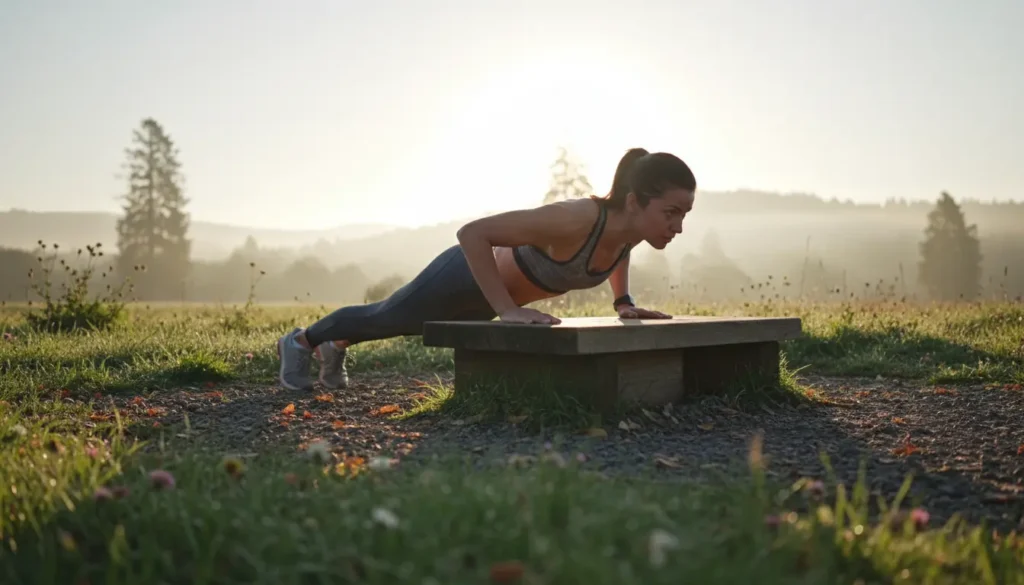
Calisthenics workout routine basics
Calisthenics focuses on bodyweight movements that develop strength, control, and mobility. This article gives a clear, practical calisthenics workout routine you can apply at home or in a park.
Why choose a calisthenics workout routine
Bodyweight training builds functional strength and often improves coordination and joint health. It requires minimal equipment and scales well from beginner to advanced levels.
Sample calisthenics workout routine (Beginner to Intermediate)
This routine runs three days a week with rest or light cardio days in between. Each session takes 30–50 minutes depending on rest and sets.
Warm-up for the calisthenics workout routine
- 5 minutes light cardio: brisk walk or jogging in place.
- Dynamic mobility: arm circles, leg swings, hip openers (5 minutes).
- Specific prep: 1 set of easier versions of main movements (e.g., incline push-ups, assisted squats).
Main workout: Full-body calisthenics workout routine
Follow the set-rep structure below. Rest 60–90 seconds between sets. Increase reps or progress difficulty when sets become easy.
- Push: Push-ups — 3 sets of 8–15 reps (knee or incline for beginners).
- Pull: Australian rows or assisted pull-ups — 3 sets of 6–12 reps.
- Legs: Bodyweight squats or split squats — 3 sets of 12–20 reps.
- Core: Plank — 3 sets of 30–60 seconds.
- Hinge: Glute bridges or single-leg bridges — 3 sets of 10–15 reps.
Optional finish: 2 rounds of a conditioning circuit — 30 seconds work, 20 seconds rest: jumping jacks, mountain climbers, and high knees.
Cooldown and mobility
Finish with 5–8 minutes of static stretching focusing on hips, chest, hamstrings, and shoulders. Controlled breathing helps recovery and reduces heart rate.
Progression and tips for your calisthenics workout routine
Progression is essential for gains. Use three main strategies: increase reps, add sets, or make movements harder.
- Move to harder variations: incline push-up → standard → decline → one-arm work.
- Use tempo: slow down eccentric phases to increase difficulty without adding weight.
- Track workouts: log sets, reps, and how a movement felt to plan progression each week.
Sample 4-week progression outline
- Week 1: Establish baseline, focus on technique and consistent sessions.
- Week 2: Add 1–2 reps per set or one additional set to major movements.
- Week 3: Introduce harder variations for one or two exercises.
- Week 4: Deload if needed or test a max rep set to gauge progress.
Equipment, space, and simple gear for calisthenics workout routine
You only need a small space and a few low-cost items for effective progress. A sturdy pull-up bar, a resistance band, and a mat are enough for most routines.
- Pull-up bar for vertical pulling progressions.
- Resistance bands for assistance or added tension.
- Parallel bars or sturdy chairs for dips and L-sit practice.
Common mistakes to avoid in a calisthenics workout routine
Many trainees rush progress or neglect mobility which leads to plateaus and injury. Maintain control and prioritize quality reps over quantity.
- Rushing reps and sacrificing form.
- Skipping warm-up or mobility work.
- Not varying intensity or failing to progress difficulty.
Calisthenics can improve balance and neuromuscular coordination because exercises require control of the whole body rather than isolating single muscles.
Case study: 8-week calisthenics workout routine progress
Maria, a busy office worker, followed the routine three times weekly for eight weeks. She started with knee push-ups and assisted pull-ups and recorded each session.
After eight weeks she increased full push-ups from 4 to 18 in a set, reduced assistance on pull-ups, and reported easier daily movement and less back stiffness. Her progress came from consistent training, tracking, and small weekly increases in reps.
Sample weekly plan for the calisthenics workout routine
- Monday: Strength session A (push, pull, legs, core).
- Tuesday: Active recovery or light cardio.
- Wednesday: Strength session B (different variations, mobility focus).
- Thursday: Rest or yoga for mobility.
- Friday: Strength session A or mixed conditioning.
- Weekend: Light activity, walking, or focused mobility work.
Final notes on your calisthenics workout routine
Stick to consistency and gradual overload for steady improvements. Adjust exercise selection and volume based on recovery, goals, and available time.
With a clear calisthenics workout routine and planned progression, you can build lasting strength and mobility without a gym membership.