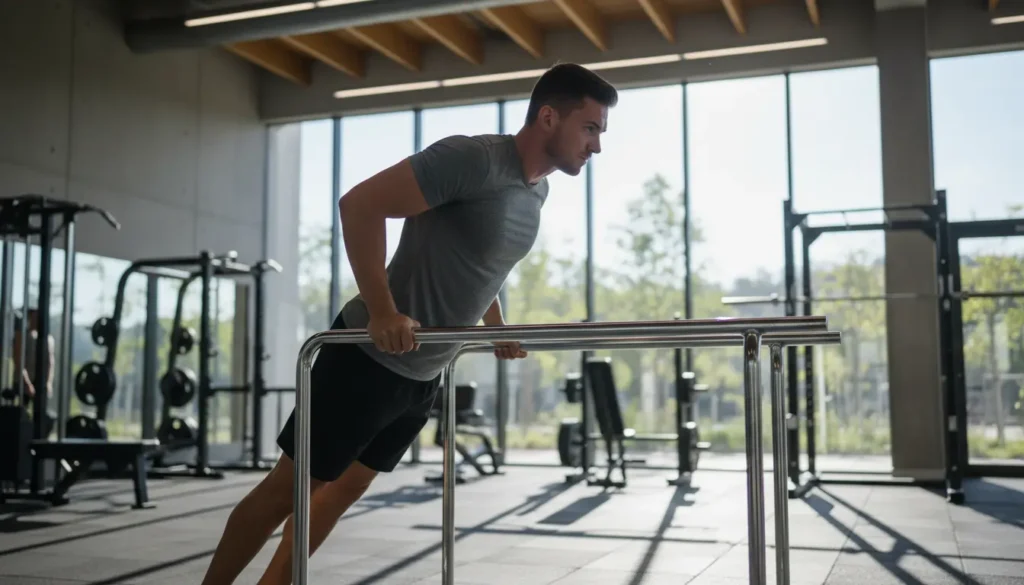
Chest dips are a simple but powerful exercise to target the lower chest and triceps. Done correctly, they increase strength and muscle size while improving shoulder stability.
Dips Workout for Chest: Why Dips Work
Dips place the shoulder in a position that emphasizes the lower pectoral fibers. They combine pressing action with deep-range stretch, which is useful for hypertrophy.
They are also highly scalable: beginners can use assistance, while advanced trainees can add weight. This makes dips a staple in many chest-focused programs.
How Dips Workout for Chest Targets Muscles
The main muscles involved are the lower pectoralis major, anterior deltoid, and triceps. Changing torso angle shifts emphasis between chest and triceps.
Leaning forward increases chest activation, while staying upright emphasizes the triceps more. Small adjustments produce different training effects.
Dips Workout for Chest: Proper Form and Setup
Good form reduces injury risk and maximizes chest recruitment. Start by using parallel bars or stable rings if you have them.
- Grip the bars slightly wider than shoulder-width to allow a natural range of motion.
- Lean forward about 20–30 degrees to shift load toward the chest.
- Keep elbows slightly flared, not pinched tightly to the sides.
- Descend until upper arms are roughly parallel to the floor or until a comfortable depth.
- Drive up by pressing through the chest and triceps, maintaining the forward lean.
Control the descent and avoid bouncing at the bottom. Maintain full shoulder control through the movement.
Warm-Up for a Dips Workout for Chest
Warming up prepares the shoulders and chest. Use dynamic mobility and activation drills for 5–10 minutes.
- Arm circles, band pull-aparts, and scapular push-ups — 2 sets of 10–15 each.
- Light incline push-ups or assisted dips for 1–2 sets of 8–12 reps to prime the pattern.
Dips Workout for Chest: Variations and Progressions
Choose a variation based on experience and goals. Progress gradually to heavier or harder versions.
- Assisted machine or band-assisted dips — for beginners working toward bodyweight dips.
- Bodyweight parallel bar dips with forward lean — classic chest-focused version.
- Weighted dips (dip belt or weighted vest) — for strength and hypertrophy progression.
- Ring dips — increase instability and require more stabilizer activation.
- Bench dips — useful for beginners but place more stress on shoulders; use cautiously.
Programming Tips for a Dips Workout for Chest
Match volume and intensity to your training phase. Use dips as a primary chest exercise or as an accessory depending on the program.
- Strength focus: 4–6 sets of 3–6 reps with added weight.
- Hypertrophy focus: 3–5 sets of 8–12 reps at a challenging but controlled pace.
- Endurance or conditioning: 2–4 sets of 15+ reps or AMRAP (as many reps as possible).
Rest 1.5–3 minutes between heavy sets for strength, and 60–90 seconds for hypertrophy work.
Common Mistakes in a Dips Workout for Chest
Avoid these errors to protect your shoulders and maximize chest engagement. Correcting form often leads to faster progress.
- Too little forward lean — shifts load to triceps rather than chest.
- Excessive depth — can strain the anterior shoulder if mobility or strength is lacking.
- Rushed reps — reduce time under tension and increase risk of momentum-based movement.
- Wide or awkward grip — can cause wrist or shoulder discomfort; use natural bar spacing.
Modifications for Pain or Limited Mobility
If dips cause shoulder pain, try these modifications. Always prioritize joint health and gradual progress.
- Switch to incline push-ups or chest presses with dumbbells to maintain chest stimulus.
- Use band-assisted dips to reduce load and improve control.
- Limit range of motion to a pain-free depth and progressively increase as mobility improves.
Sample Dips Workout for Chest
Here is a practical session you can use after a general warm-up. Adjust sets, reps, and load to your level.
- Warm-up: 5–10 minutes mobility and 2 sets assisted dips (8–12 reps)
- Main: Weighted or bodyweight dips — 4 sets of 6–10 reps
- Accessory: Incline dumbbell press — 3 sets of 8–12 reps
- Accessory: Band pull-aparts — 3 sets of 12–15 reps
- Finish: Light push-up variation or chest stretch — 2 sets
Progress by increasing reps, adding small weight increments, or reducing assistance over weeks.
Leaning 20–30 degrees forward during dips can significantly increase pectoral activation compared with a vertical torso. Small technique changes change muscle emphasis.
Dips Workout for Chest: Real-World Example
Case study: Anna, a recreational lifter, added weighted dips to her routine twice weekly. She began with bodyweight dips for 3 weeks, then added 5–10 lb increments on a dip belt.
After 8 weeks she increased her dip max from 10 reps bodyweight to 8 reps with 20 lb added and reported noticeable fullness in the lower chest. She combined dips with incline presses and adequate protein intake.
Key Lessons from the Example
- Start with consistent practice before adding load.
- Progress in small increments for steady strength gains.
- Complement dips with accessory work and recovery to improve results.
Closing Tips for Your Dips Workout for Chest
Keep sessions consistent and focus on controlled technique. Track sets, reps, and load to measure progress over weeks.
If unsure about shoulder health, consult a qualified coach or physiotherapist before heavy loading. With the right setup, dips are a reliable tool for building a stronger chest.