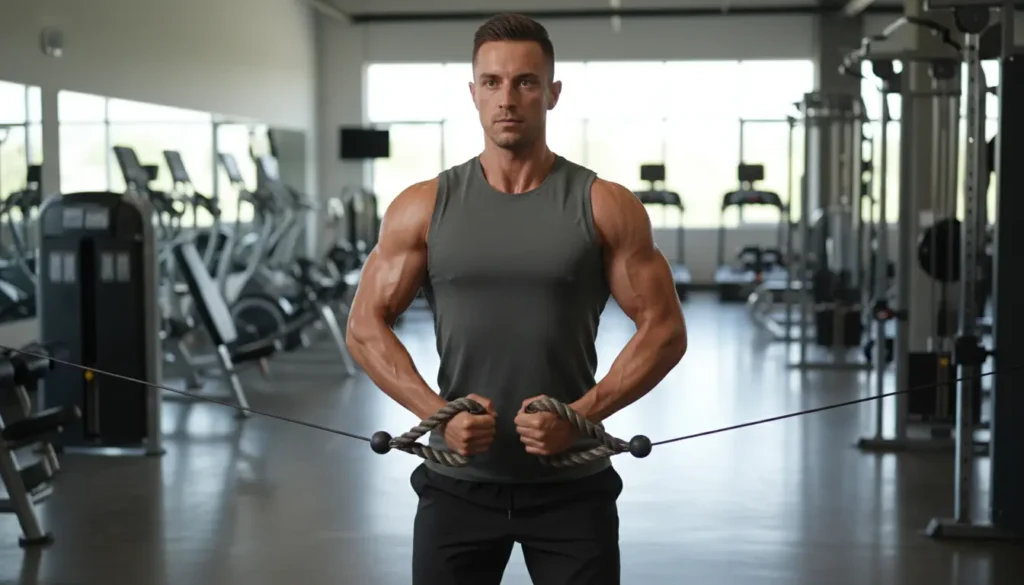
Face pulls are a simple, high-value exercise for shoulder health, rear deltoid development, and posture correction. This guide explains how to perform a face pulls workout safely, how to program it, and common errors to avoid.
What is a Face Pulls Workout?
A face pulls workout centers on the face pull movement, typically done with a cable or resistance band. The motion pulls the hands toward the face while externally rotating the shoulders, emphasizing the upper back and posterior shoulder muscles.
This exercise is low-impact and accessible, making it useful for people recovering from desk-related posture issues or those adding balance to pressing-dominant routines.
Muscles targeted by the face pulls workout
- Posterior deltoids (rear delts)
- Rhomboids and middle trapezius
- Rotator cuff muscles (external rotators)
- Upper back stabilizers
How to perform a face pulls workout safely
Follow these steps to perform face pulls with proper technique. Use light to moderate resistance to start, focusing on form over load.
- Set the cable pulley or band at upper-chest to eye level and attach a rope or grippy handle.
- Grip the ends with palms facing inward. Step back until there is tension in the cable or band.
- Stand tall with a slight knee bend, chest up, and shoulders down away from the ears.
- Pull the handles toward your face, flaring the elbows out. Aim to bring hands beside the ears, squeezing the shoulder blades together.
- Pause 1 second at the end of the movement, focusing on external rotation so your thumbs point behind you.
- Return slowly to the start, controlling the eccentric phase.
Key cues for a safe face pulls workout
- Keep the spine neutral and avoid shrugging the shoulders upward.
- Use a controlled tempo—no momentum or jerks.
- Choose a weight that allows clear scapular retraction and external rotation.
Common mistakes during a face pulls workout and how to fix them
Many people perform face pulls with too much weight or poor alignment. Here are common errors and corrections.
- Too heavy: Reduce resistance until you can hold proper form for 10–15 reps.
- Shoulder shrugging: Cue “down and back” to lower the shoulders before each rep.
- Using only arms: Focus on squeezing the scapulae to engage the upper back.
- Short range of motion: Pull to face level and rotate externally for full activation.
How to program the face pulls workout in your routine
Face pulls are versatile and can be included in warm-ups, accessory work, or rehabilitation protocols. Frequency and volume depend on goals.
General recommendations:
- Posture and shoulder health: 2–4 sets of 12–20 reps, 2–3 times per week.
- Muscle growth for rear delts: 3–4 sets of 8–15 reps, 2–3 times per week.
- Rehab and mobility: 2–4 sets of 15–25 reps, focusing on slow, controlled reps.
Include face pulls as an accessory after heavy pressing work or as part of a shoulder health circuit. Track load by increasing resistance only when you can maintain perfect form for the assigned rep range.
Sample face pulls workout placements
- After bench press: 3 sets x 12 reps at moderate resistance.
- Upper-body day finish: 4 sets x 15 reps focusing on tempo.
- Warm-up for overhead work: 2 sets x 20 reps with a band to prime the rotator cuff.
Equipment variations for the face pulls workout
Face pulls can be performed with cables, resistance bands, or even light dumbbells in horizontal rows with external rotation. Each option has pros and cons.
- Cable machine: Consistent tension and easy load progression.
- Resistance band: Portable, inexpensive, and gentle on joints.
- Rope attachment: Encourages external rotation and safe hand positioning.
Choose the option that matches your goals and the equipment available. Bands are excellent for rehabilitation and home workouts, while cables are ideal for precise loading in a gym.
EMG studies show that face pulls activate the posterior deltoids and upper back muscles effectively, making them one of the best single exercises for shoulder balance and posture.
Real-world example: Case study
Client profile: Mark, 35, office worker with rounded shoulders and mild upper-back pain. He added a face pulls workout twice a week for 8 weeks.
Program used: Two sessions per week, 3 sets x 15 reps with a band in week 1, progressing to 3 sets x 12 reps with cable at moderate load by week 6. He focused on scapular squeeze and external rotation.
Outcome: After 8 weeks Mark reported less neck tension, improved posture while seated, and greater shoulder stability during pressing movements. He continued face pulls twice weekly as maintenance.
Final tips for consistent progress with the face pulls workout
- Prioritize technique over load; quality beats quantity for shoulder health.
- Keep a training log: record resistance, sets, reps, and notes on form.
- Combine with thoracic mobility work and stretching for best posture results.
- If you have shoulder pain, consult a physical therapist before adding heavy variations.
When programmed and performed correctly, a face pulls workout is a small time investment with outsized benefits for posture, muscular balance, and long-term shoulder integrity.